



Quick answer
Aromatherapy candles work by routing scent molecules to the limbic system, where they shift mood, lower cortisol, and ease anxiety. The mechanism is real neuroscience, supported by lavender, bergamot, and citrus studies. They are not a cure for stress or insomnia, and the "essential oils only" rule is mostly marketing. Heat degrades many essential oils, while well-formulated fragrance oils can produce the same neural response.
"Aromatherapy candles" are an interesting category to dig into. Some of what gets claimed about them holds up under research. Some of it doesn't, and the science behind why is its own kind of fun.
We got curious about this while working on our own candles. The pathway from scent to mood is real and measurable, and there is a small but consistent body of research on specific scents (lavender for sleep, bergamot for stress, citrus for mood) that holds up under scrutiny. At the same time, a lot of the rules around what counts as a "real" aromatherapy candle (essential oils only, more fragrance equals more benefit) don't quite line up with how the underlying biology actually works.
This piece walks through what the research supports, where the marketing tends to get ahead of the evidence, and what to look for if you want a candle that's pleasant to live with as part of a wind-down routine.
What Happens in Your Brain When You Smell a Candle
Olfaction is the only sense in your body that bypasses the thalamus, and that one fact does most of the heavy lifting in any honest aromatherapy explanation.
Why smell skips the thalamus
Olfaction is the only sense that reaches emotion and memory without a relay
SIGHT, SOUND, TOUCH, TASTE
- eye ear skin tongue
- Thalamusswitchboard / relay
- Cortexconscious interpretation
A small beat between input and feeling
SMELL
- nose
- Olfactory bulbfirst stop
- no relayAmygdalaemotionHippocampusmemory
You feel it before you think it
Diagram contrasting how four senses (sight, sound, touch, taste) all route through the thalamus before reaching the cortex, while olfaction projects directly from the olfactory bulb to the amygdala and hippocampus, bypassing the thalamic relay.
Here's what it means in practice. Every other sensory input, including sight, sound, touch, and taste, gets routed through the thalamus first. The thalamus is the brain's switchboard. It processes, prioritizes, and forwards signals on to higher cognitive regions where you consciously interpret them. There's a small beat between the input and the feeling.
Smell skips that step. A scent molecule lands on a receptor in your nose, the olfactory bulb fires, and the signal goes directly to the amygdala (where emotion is processed) and the hippocampus (where memory is formed). You feel it before you think it.
That's why scent can trigger emotional and memory responses so quickly, and why those responses tend to feel visceral rather than considered. Olfaction is also the oldest sense in evolutionary terms, predating the thalamus that other senses depend on.
There's also a speed dimension worth knowing. The signal from a scent molecule reaches the amygdala in roughly half a second, well before you've consciously identified what you're smelling. By the time your prefrontal cortex labels the scent ("oh, lavender"), the emotional response is already in motion. That's part of why scent can feel sneaky compared to other senses. You feel something shift before you know why.
So the underlying pathway is real and well-mapped. Whatever else is true about specific oils or specific candles, the route from nose to feeling is solid neuroscience. The interesting questions are how much effect a candle actually delivers, how predictable that effect is, and what shapes it. We covered the brain-side of this story in more depth in our piece on scent and memory, and the combustion physics of a burning candle in how candles work.
Break for research
Help us figure out our next scents
These scents are top of nose right now. Give us your opinion.
- Cashmere plumSmells like: ripe plum over soft woods
- Himalayan bambooSmells like: fresh-cut green stems
- PetrichorSmells like: the first rain on warm ground
- Coriander and limeSmells like: lime zest with a peaty, smoky edge
Want to hear which ones make it?
We'll email you the results and which scents go into testing.
Thanks!
You're on the list. Check your inbox.
There was an error. Please refresh the page and try again.
Unsubscribe anytime. Your vote counts whether or not you sign up.
What the Studies Actually Show
The research base on aromatherapy is uneven. Some claims have solid evidence behind them, others are thinner than the wellness world suggests. Here's what some of the better-designed studies have found.
Lavender and sleep. Multiple controlled trials and meta-analyses have shown that inhaled lavender improves self-reported sleep quality, increases the proportion of slow-wave (deep) sleep, and reduces nighttime arousals in adults with mild sleep disturbance. The effect sizes are modest but consistent across studies, particularly for subjective sleep quality measured by the Pittsburgh Sleep Quality Index.
Bergamot and cortisol. A 2015 study in Forschende Komplementärmedizin (also indexed as Research in Complementary Medicine) tested bergamot essential oil inhalation on 41 healthy women using a crossover design. Participants who inhaled bergamot vapor showed significant decreases in salivary cortisol, increases in high-frequency heart rate variability (a parasympathetic activation marker), and improved mood scores compared to control conditions.
Citrus and mood. Smaller studies on citrus oils, particularly lemon and orange, have found increases in self-reported alertness and positive mood, with some evidence of effects on autonomic nervous system markers.
Continuous exposure and brain structure. A 2024 study in Behavioural Brain Research reported that continuous essential oil inhalation over a sustained period correlated with measurable changes in gray matter volume in olfaction-related brain regions, suggesting the system can be trained.
A few caveats worth holding alongside these findings. Most aromatherapy studies test inhalation in tightly controlled laboratory settings (sealed rooms, standardized concentrations, validated essential oil samples). Translating those results to a candle burning on your nightstand brings in a lot of variables: room volume, fragrance load, ventilation, and which molecules actually survive the flame. Real-world effects are likely smaller than the lab results suggest. The mechanism is the same. The dose just isn't as controlled.
It's worth being clear about the ceiling on this evidence. Sample sizes are often small. Effect sizes are modest. Most studies test inhalation in controlled settings, not candles in living rooms. Aromatherapy candles can support mood and ritual. They aren't medicine, and we'd rather say that plainly than imply more.
The Essential Oils vs. Fragrance Oils Question
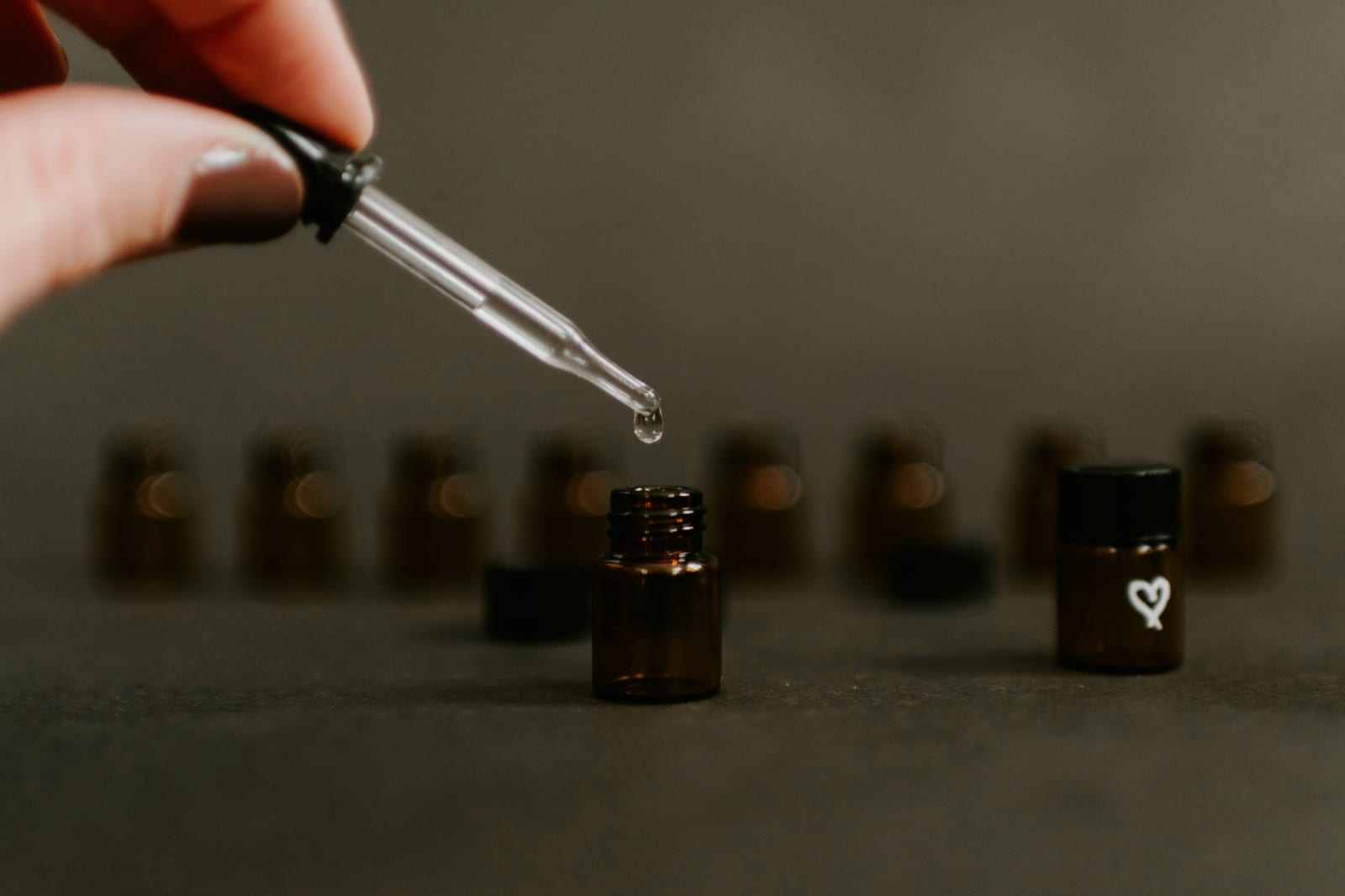
The standard line in aromatherapy candle content is that real aromatherapy requires essential oils, and synthetic fragrance doesn't count. This is one of those rules that sounds intuitive but gets a little complicated when you look at how scent and the brain actually interact.
Two things make the rule less clean than it appears. First, candle flame temperatures are pretty intense (the wick base reaches several hundred degrees Celsius), and that heat degrades many of the volatile aroma compounds in essential oils. Some essential oils, including cinnamon, clove, and certain citrus oils, can release acrolein, formaldehyde, or other irritants during incomplete combustion. A few professional aromatherapy organizations exclude candles from clinical aromatherapy definitions for this reason. The delivery format isn't ideal for the chemistry.
Second, your limbic system doesn't know where a molecule came from. Olfactory receptors respond to molecular shape. A linalool molecule produced by a lavender plant and a linalool molecule synthesized in a fragrance lab generate the same neural signal in the same receptors. The brain responds the same way because, at the level it's measuring, the input is the same.
That's why a well-formulated, phthalate-free fragrance oil candle can produce a mood response similar to an essential oil candle, sometimes more consistently. Fragrance compounds engineered for candles tend to be more heat-stable, the composition stays consistent batch to batch, and the allergen profile is more predictable.
None of this is meant to dunk on essential oils. They have a real place: diffusers (where heat is gentler), massage oils, steam inhalation. The candle format just isn't where they shine.
The International Federation of Professional Aromatherapists, one of the larger certifying bodies for clinical aromatherapists, doesn't classify candles as a clinical aromatherapy modality, citing the heat-alters-chemistry issue. We found that interesting when we came across it, since it doesn't show up much in candle marketing.
| Essential oils | Phthalate-free fragrance oils | |
|---|---|---|
| Signal at the receptor | Molecular shape | The same molecular shape |
| Batch to batch | Varies with crop and harvest | Specified and repeatable |
| Allergen profile | Set by the plant | Can be formulated around |
| Where it performs best | Diffusers, steam, massage oil | Under a candle flame |
We use phthalate-free fragrance oils for our own candles for a few reasons. We can specify exactly what's in them, hold suppliers to a published standard, and know how the compounds behave under flame. We can also leave out the specific compounds most likely to produce irritants during incomplete combustion, whether they originated as essential oils or synthetics. The takeaway isn't that synthetic equals safe. It's that the kind of clean-burning aromatherapy candle we want to make is easier to build when we have control over the individual compounds going in. We talked through the broader trade-off in our piece on essential oils versus fragrance oils.
Why heat-stable compounds matter in a candle
Approximate stability ranges, mapped against where compounds actually travel
- Cooler
- Hotter
-
The candle's thermal environment
from the melt pool up through the warm air above the flame -
Essential oil compounds
citrus, lavender, bergamot lose structure here -
Engineered fragrance compounds
formulated to survive candle conditions
A horizontal axis running from cooler to hotter shows where two compound families lose their structure. Many essential oil compounds (citrus, lavender, bergamot) start to break down within the heat a burning candle reaches. Engineered fragrance compounds designed for candle use stay stable beyond it. A shaded band labeled "the candle's thermal environment" covers the melt pool surface up through the convection zone above the flame. The band overlaps the upper end of essential oil stability but remains inside the engineered fragrance stability range.
Approximate ranges. Specific thresholds vary by compound. The flame itself is far hotter, but most fragrance reaches your nose without traveling through it.
Why Lighter Loads Often Outperform Heavy Ones
Most candles on the market are scented as heavily as they can be without affecting the burn. The intuition makes sense: more fragrance equals more aromatherapy effect. The biology suggests it works the other way, in two related ways.
First, your olfactory receptors adapt to any constant scent within 15 to 30 minutes. This is olfactory fatigue, also called nose blindness. Heavier fragrance loads tend to saturate receptors faster, which is part of why the candle that hits hardest at minute one is often the candle you can barely smell by minute thirty. We walked through the mechanism in detail in our piece on nose blindness.
Second, the aromatherapy benefit (to the extent any individual candle delivers one) seems to come from sustained, gentle exposure paired with context. A 2022 review in Frontiers in Pharmacology on inhalation aromatherapy noted that dose, duration, and the conditioning context all shape the response. The candle is doing two jobs at once: delivering molecules to your olfactory system, and serving as a behavioral cue you've associated with whatever state you're reaching for. The second job has more to do with habit than with chemistry.
A heavily scented candle in a small room runs up against the receptor adaptation problem without adding anything to the conditioning side. A lighter, sustained scent paired with a consistent ritual (the same room, around the same time, paired with reading or wind-down) tends to produce a more durable response over time.
The conditioning piece is also part of why a candle can work well as a mood cue compared to a diffuser, even though the diffuser delivers molecules more cleanly. The visual ritual matters. Striking a match, watching the flame settle, the wood wick crackle. Those are sensory anchors that pair with the scent. Over time the cue itself does some of the work.
This is part of why we keep our own fragrance load on the lighter side. The trade-offs are real and we don't hide them: subtler scent throw, less of an immediate "wow" when you first walk in, and slower habituation. We've found that combination works better for the way most people actually live with a candle, but it's a preference, not a universal rule.
- 1Pick for the response, not the storyEvening leans lavender, bergamot, sandalwood or cedarwood. Daytime leans citrus.
- 2Keep the room and the hour the sameThe candle is also a behavioral cue, and repetition is what makes the cue carry part of the load.
- 3Judge it by the hour, not the entranceReceptors adapt within 15 to 30 minutes, so the first ten minutes tell you very little.
- 4Choose a load you can sit withA lighter, sustained scent outlasts one that saturates the room and then disappears.
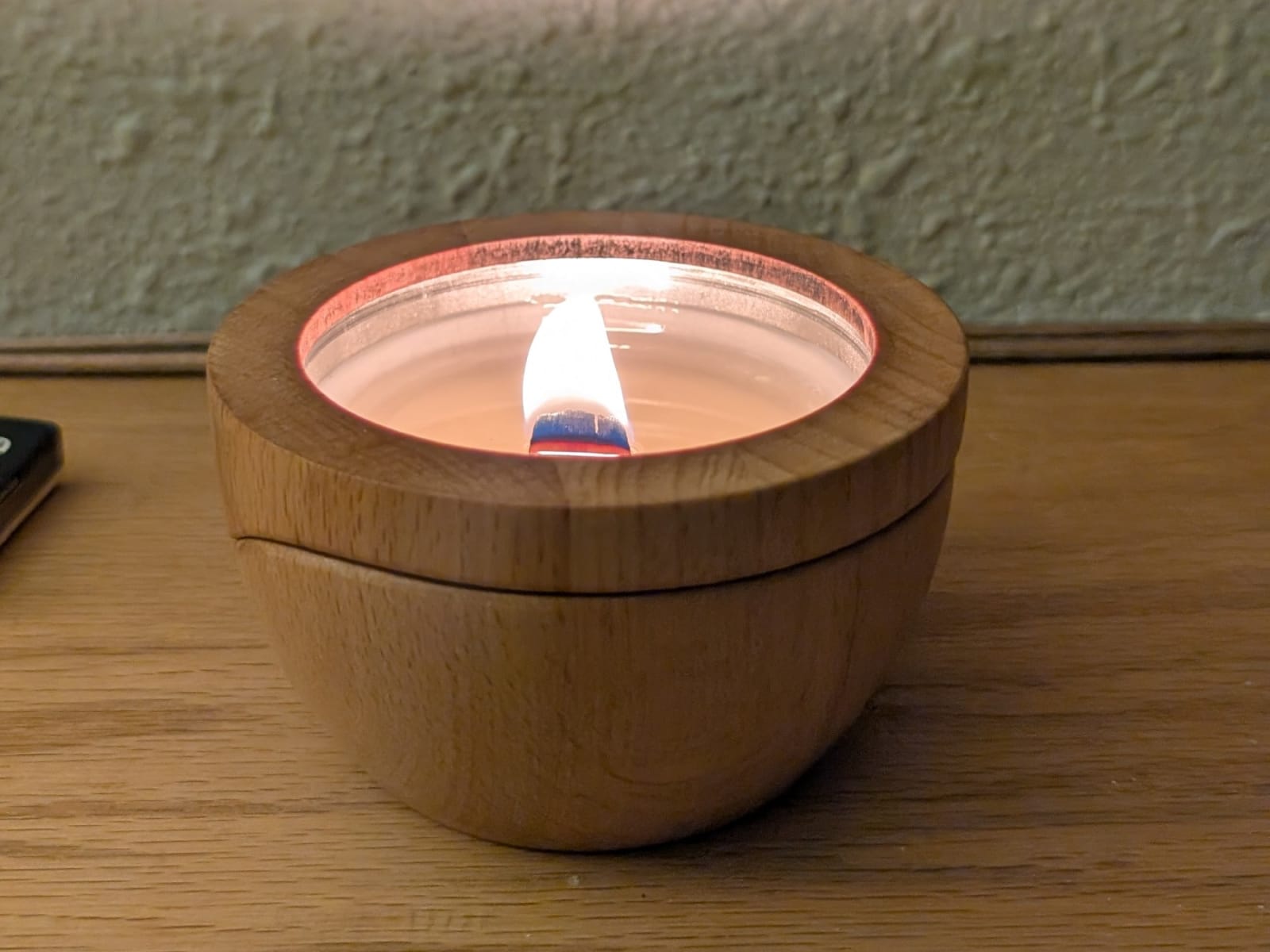
Scents Worth Considering (And What They Actually Do)
Once you stop worrying about whether the scent is "essential oil" or "fragrance oil" and start asking what mood response it produces, the picking gets easier. Here is what the better-supported evidence says about commonly used aromatherapy scents.
Lavender. The most-studied aromatherapy scent, with the strongest evidence for sleep onset, slow-wave sleep, and cortisol reduction. If you are reaching for one mood scent, this is the default for evening.
Bergamot. Behaves differently from other citrus oils. Studied for parasympathetic activation, salivary cortisol reduction, and mood improvement, with measurable effects in controlled inhalation studies. Good for the transition out of a stressful day rather than as a wake-up scent.
Other citrus (lemon, orange, grapefruit). Smaller studies suggest mood elevation and alertness, especially in morning or working contexts.
Sandalwood and cedarwood. Activate the parasympathetic nervous system in some studies. Useful for grounding, particularly when paired with breath work or meditation.
Eucalyptus and peppermint. Associated with focus and respiratory clarity. Both warrant caution in homes with cats or small dogs, where they can be irritating or toxic in concentrated forms. We walked through pet safety in our pet parents guide.
Rose, jasmine, ylang ylang. Often included in aromatherapy claims but with thinner evidence bases. Useful for mood if you respond to them personally, less defensible as targeted neurochemical interventions.
One note on the scents that don't usually show up in aromatherapy research. Seasonal favorites like cinnamon, clove, vanilla, and gourmand profiles have very little clinical evidence behind them, and some (cinnamon and clove especially) are among the compounds most prone to producing irritants under incomplete combustion. They're still genuinely mood-positive for a lot of people, mostly because they pair with the rituals of comfort. We're not knocking that. It's just worth knowing the lift is mostly association, not measured neurochemistry.
Scents and their evidence-backed effects
Scents at a glance
Where the research actually points
- LavenderSleep onsetSlow-wave sleepCortisol reductionStrongest evidence base.
- BergamotSalivary cortisol decreaseParasympathetic activationWind-down, not wake-up.
- CitrusMood elevationAlertnessLemon, orange, grapefruit.
- SandalwoodGroundingParasympathetic engagementPairs with breath work.
- CedarwoodParasympathetic activationCalming, groundingSandalwood neighbor.
- EucalyptusFocusRespiratory clarityCaution near pets.
Six commonly used aromatherapy scents (lavender, bergamot, citrus, sandalwood, cedarwood, eucalyptus) mapped to their dominant evidence-backed mood or physiological effect, with a note that eucalyptus warrants caution in homes with pets.
Match the scent to the response you want, not the wellness narrative. Rose, jasmine, ylang ylang and gourmand profiles have thinner evidence bases.
A simple way to pick: choose the scent that matches the response you want, rather than whichever one has the trendiest wellness story. Our three profiles (Renew, Uplift, Unwind) are organized around specific mood directions rather than trying to cover every scent family. Renew sits in the eucalyptus-juniper-santal range for clarity. Uplift is in the citrus-mint-grapefruit territory for daytime mood. Unwind leans into sage-cypress-smoked-oud for evening grounding. We landed on three because most people end up wanting some rotation rather than one all-purpose scent.
What the Label Can Tell You
Most aromatherapy candle marketing copy is generic across brands, but the label itself does carry a few signals worth checking before you buy. The rest of what makes a candle good (a clean burn, a wick sized right, a fragrance load that does not fatigue you in ten minutes) you really only know by burning it. The label cannot promise those things. It can tell you whether the brand is being upfront about what is inside, which is a reasonable filter for what to try first.
What the label can and can't tell you about an aromatherapy candle
Reading the label
What the jar itself can tell you, and what to skip past
LOOK FOR
-
Phthalate-free fragrance disclosure
Specific, not "proprietary." -
Wax type, named
Soy, blend, coconut, beeswax. -
Full ingredient list
Wax, wick, fragrance, container. -
Brand willing to be specific
Real names beat marketing words.
SKIP PAST
-
"Proprietary fragrance"
No detail = nothing to verify. -
Therapeutic medical claims
No candle treats a condition. -
"All natural" with no ingredient list
Marketing word, not a spec. -
"100% EO" with no flame disclosure
Heat changes the chemistry.
Two columns of label-readable signals: four to look for (phthalate-free fragrance disclosure, named wax type, full ingredient list, transparent fragrance composition) and four to skip past (proprietary fragrance, therapeutic medical claims, all-natural with no ingredient list, 100 percent essential oil with no flame disclosure).
A useful first filter. The rest of what makes a candle good only shows up after you burn it.
A few label patterns are worth treating as quiet flags: claims that a candle treats a specific medical condition, "all natural" with no ingredient list, "proprietary fragrance" left undefined, and "100% essential oil" with no acknowledgment of the heat-degradation question. None of these are deal-breakers on their own, but they tend to cluster on candles where the marketing is doing more work than the formulation.
We covered our own choices in the Sero Standard, and the full ingredient breakdown lives on our ingredients page.
The Bottom Line
The pathway from scent to mood is real, well-mapped neuroscience. Olfactory signals reach the limbic system without going through the thalamus first, which is why a smell can shift how you feel before you've consciously identified it. The studies on lavender, bergamot, and citrus are imperfect but consistent: these molecules produce measurable effects on cortisol, sleep, and mood under controlled conditions.
What the research doesn't fully back is the broader marketing version of aromatherapy. Essential oils aren't strictly required (your brain responds to molecular shape, not provenance), the heat of a candle flame complicates the chemistry in ways most labels don't address, and no candle is going to substitute for therapy or sleep hygiene. The lighter, sustained, ritual-paired version of an aromatherapy candle tends to do more for most people than a heavily scented one.
So: pick the scent that matches the response you're after. Look for transparent ingredients, a clean burn, and a fragrance load you can comfortably live with for an hour. Pair it with the same context each time. Treat it as one piece of a wind-down or focus routine, not as a treatment. That's a reasonable thing to ask of a candle, and most of the rest of the marketing is asking for more than it can deliver.
Sources
- Cleveland Clinic, "Aromatherapy: Does It Work?"
- Watanabe E, et al., "Effects of Bergamot Essential Oil Aromatherapy on Mood States, Parasympathetic Nervous System Activity, and Salivary Cortisol Levels in 41 Healthy Females," Forschende Komplementärmedizin, 2015 (PMID: 25824404)
- Cheong MJ, et al., "The Effect of Lavender on Sleep Quality in Individuals Without Insomnia: A Systematic Review," Holistic Nursing Practice, 2022 (PMID: 35708558)
- "Continuous inhalation of essential oil increases gray matter volume," Behavioural Brain Research, 2024
- "The unknown risks of scented candles! What science has to say: an editorial," PMC, 2024
- "Inhalation Aromatherapy via Brain-Targeted Nasal Delivery: Natural Volatiles or Essential Oils on Mood Disorders," Frontiers in Pharmacology, 2022
Frequently Asked Questions
Do aromatherapy candles actually work?
Yes, in a specific way. Scent travels directly from your nose to the limbic system, the brain region governing emotion and memory. Studies show lavender lowers cortisol and improves sleep, bergamot eases anxiety, and citrus elevates mood. The effect is measurable but modest. Aromatherapy candles support mood and ritual. They do not treat clinical anxiety, depression, or insomnia.
Are essential oil candles better than fragrance oil candles for aromatherapy?
Not necessarily. Candle flame temperatures degrade many essential oil compounds, and some essential oils release irritants like acrolein during incomplete combustion. Your limbic system responds to molecular shape, not whether a molecule came from a plant or a lab. A well-formulated, phthalate-free fragrance oil candle can deliver the same mood response, often more consistently.
What scents are best for anxiety and stress?
Lavender has the strongest evidence base for stress and sleep, with multiple studies showing reduced cortisol and improved sleep onset. Bergamot has been shown to lower salivary cortisol and improve mood in healthy adults. Sandalwood and cedarwood activate the parasympathetic nervous system. Citrus oils elevate mood and alertness. Pick the scent that matches the response you want.
How long does it take an aromatherapy candle to work?
Within minutes. Olfactory signals reach the amygdala in under a second, and physiological changes like cortisol shift can begin within 15 minutes of exposure. The catch: your nose adapts to constant scent in 15 to 30 minutes. Lighter fragrance loads delay that adaptation, which is why subtler candles often deliver longer perceived benefit than heavily scented ones.
Can aromatherapy candles replace therapy or medication?
No. Aromatherapy supports mood and creates a calming ritual, but the evidence base shows modest effects on stress, sleep quality, and anxiety symptoms, not cures. Major clinical organizations do not recommend candles as a primary treatment for any condition. Use them as part of a broader wellness practice that includes sleep, exercise, professional care, and medication if prescribed.
Are aromatherapy candles safe to burn often?
For most people, yes, when the candle uses a clean-burning wax (soy or soy blend), a properly sized wick, and phthalate-free fragrance. Burn in well-ventilated rooms, trim the wick before each light, and watch for smoke (a sign the wick is too long or the candle is poorly made). People with asthma or fragrance sensitivities should test cautiously.


