


In February we flew out to Baltimore for a brand photoshoot. Three days in a studio with a photographer, an art director, two models, and a crew who built an entire living room from scratch just so they could shoot in it.
Almost everything you see here came out of those three days. The candle on the nightstand, the hand lowering a candle onto a linen table, the wood container held up against a warm clay wall. We're still using all of it.
We got to work with the people who made it because they were our neighbors when we lived in Baltimore, which is a good argument for staying in touch with the people on your street.
Who made it happen
Limonata Creative is a studio in Baltimore run by Giulietta Pinna and Nate Bachmann. They describe themselves as the agency for people who don't want to look like everyone else, which is the kind of line a lot of studios write and not many can back up.
Theirs is backed up. Their styling has been on the cover of House Beautiful and on the cover of the Washington Post Magazine. They worked on The World Central Kitchen Cookbook for Clarkson Potter and on two books for National Geographic, and their work shows up in Architectural Digest, Martha Stewart, Domino and the Wall Street Journal.
Before any of that she spent close to a decade in New York working in blue chip galleries and in contemporary artists' studios, handling and arranging objects for people who cared enormously about how objects get handled and arranged. She's also a certified sommelier, which sounds like a detour until you think about it, because both jobs come down to noticing differences most of us can't see yet and then being able to say out loud what the difference is.
Nate has been building brand identities for close to twenty years, including work for Levi's, Brooks Brothers and Judith Leiber. He also designed Sero. The logo, the packaging, the whole visual system came from him long before there was a product photo to take.
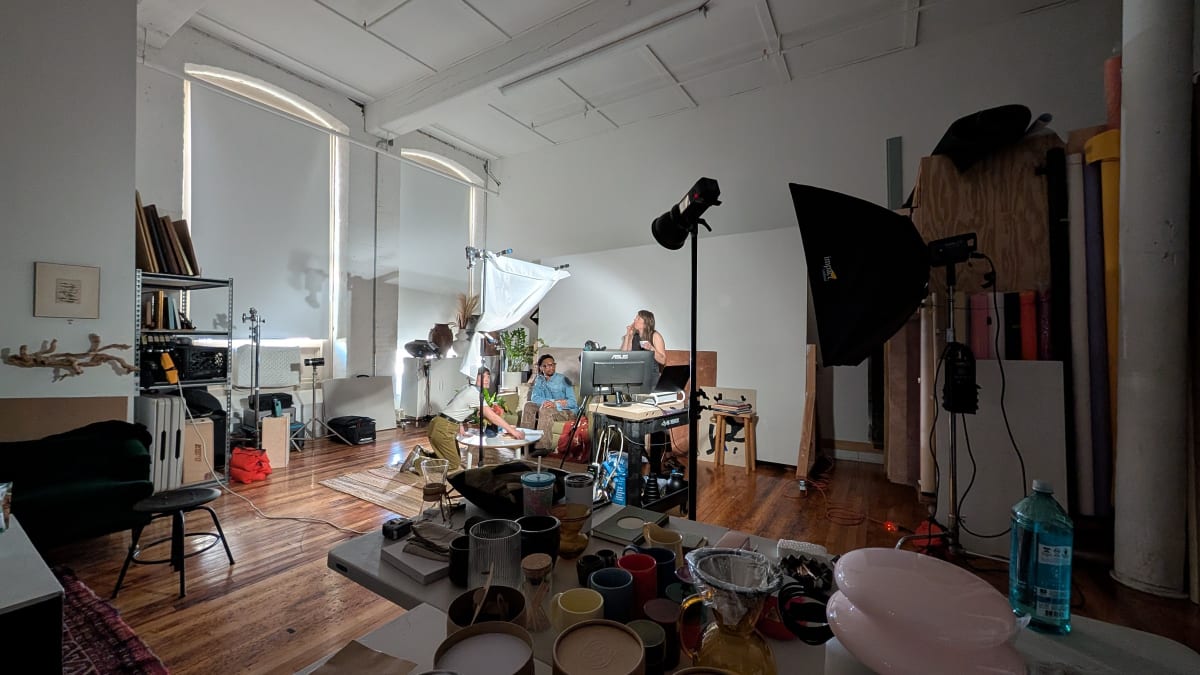
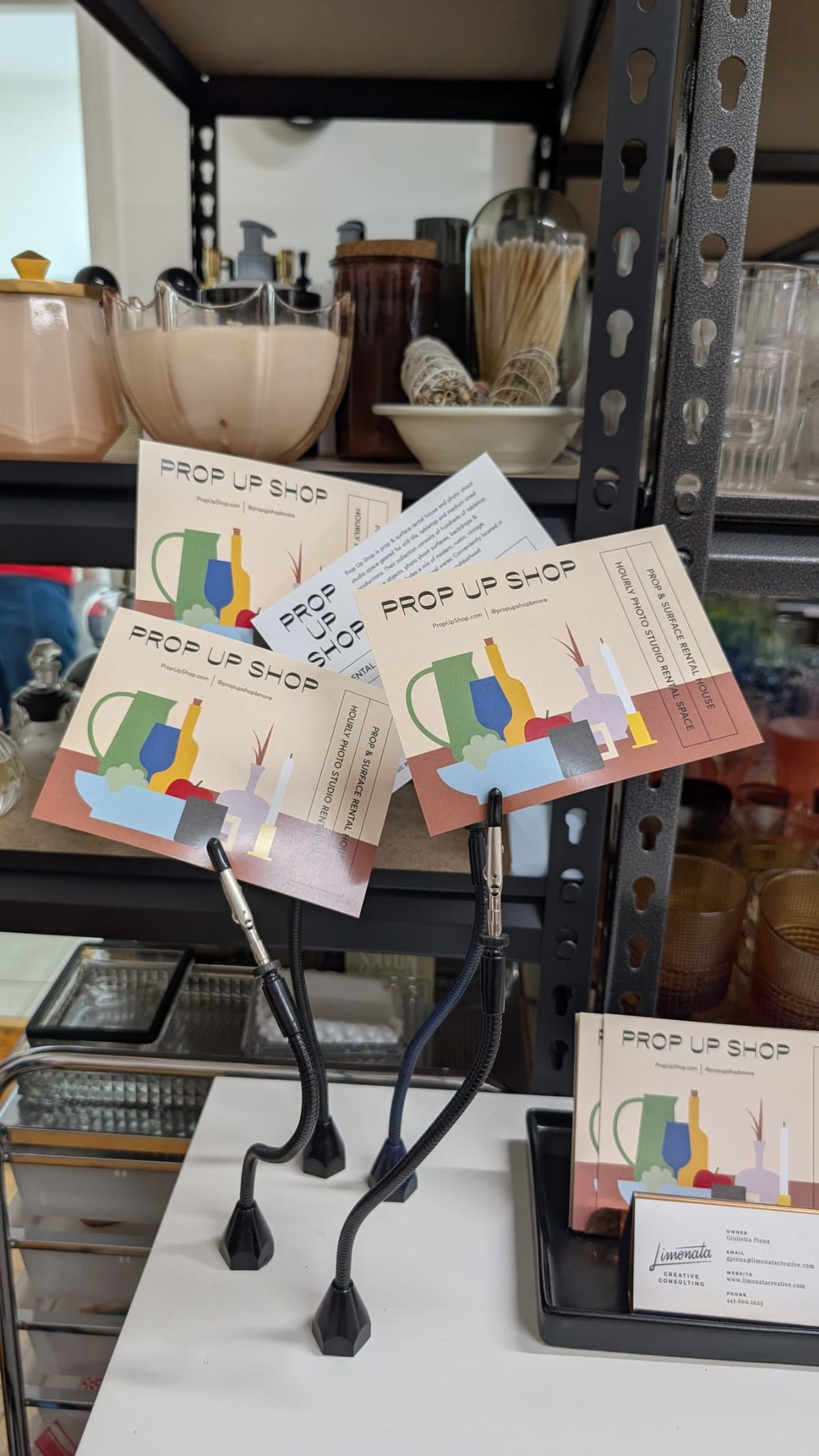
They own Prop Up Shop too, which is the first prop house in the Baltimore and DC region. Prop houses are mostly a New York and LA thing, so outside those cities stylists usually end up buying props at retail and returning them afterward. Giulietta's is a working inventory: thousands of objects and more than a hundred backgrounds and surfaces, plenty of them hand-painted in house. It started as overflow in her basement, and it's the room our shoot got built out of.
Emily Marie Schultz shot it. She has shot national wine campaigns, and she works the way the best small-crew people do, which is that she can be the photographer on somebody else's set or run the art direction, styling, set building and retouching herself. Other photographers hire her to art direct their shoots. For one client she built convincing under-sink kitchen environments inside a studio and retouched them into place.
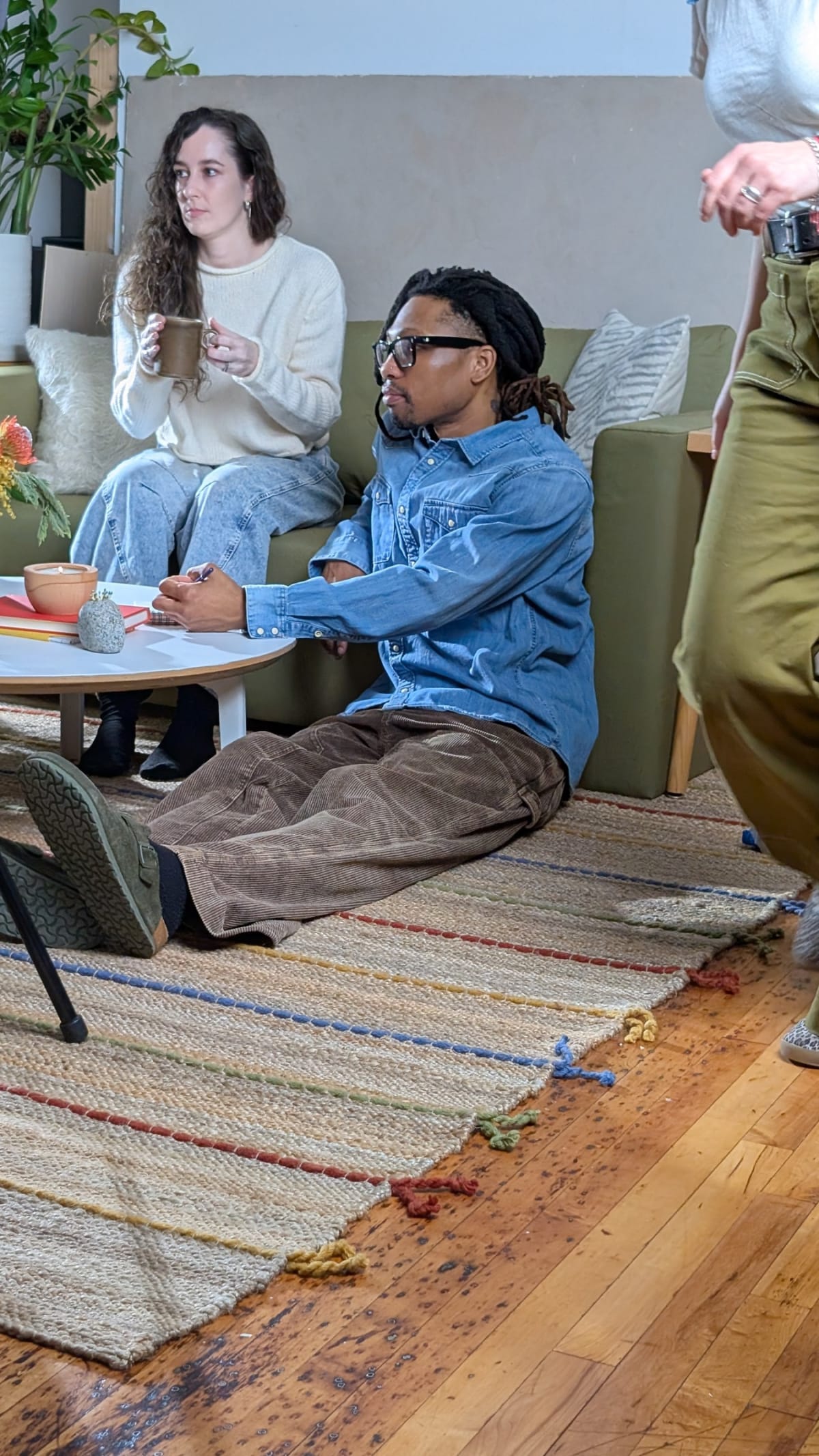
Nick Wright came in from a DC agency to model, and Chelsea Baldwin came for the product-shoot experience and wound up doing double duty as model and styling assistant.
Honestly, a company our size doesn't usually get to work with people at this level, and it's worth explaining why we did.
Part of it is that we know them. The bigger part is that Giulietta and Nate keep room in their schedule for small brands on purpose, and they price that work differently. It isn't a discount you can call up and ask for, it's a choice about which projects they want to spend their time on. They're open that it goes both ways, since a small company doing something unusual gives them work they're excited to show, and there's more room to make something interesting when nobody's protecting a category. They also make a lot less on those projects than they otherwise would, and they keep doing it anyway, because they like helping novel little companies get somewhere.
So we got lucky twice. We knew them, and we were the kind of project they save room for.
The plan was one day
Back in December the first estimate was that a single day would cover it.
By the time we got there it had grown into a build day, a full shoot day, and a half day of product work, which is what it takes to make a room and then photograph it. We didn't understand that until we watched it happen.
We sent over a brief in January with everything we thought mattered, and looking back the useful part was the short list of things we didn't want. No bathtub-and-wine-glass candle clichés, nothing glossy competing with the aluminum, warm light rather than bright. Everything else across those three days came from them.
One thing had changed while we were planning. We'd started selling the aluminum candle on its own rather than only as part of the refill system, so the shot list had to carry two products instead of one. Giulietta rebuilt it around that without much fuss.
Day 1: building the room
We landed at 11:30 on Thursday and got to the studio by half past twelve, and they were already building.
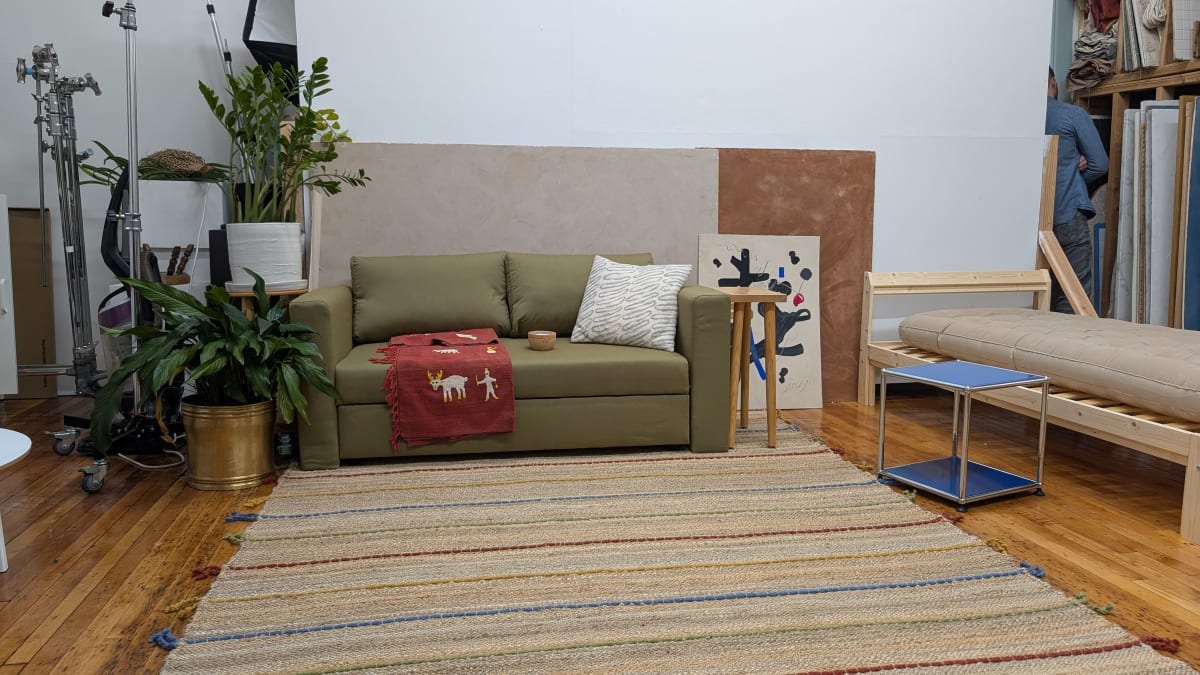
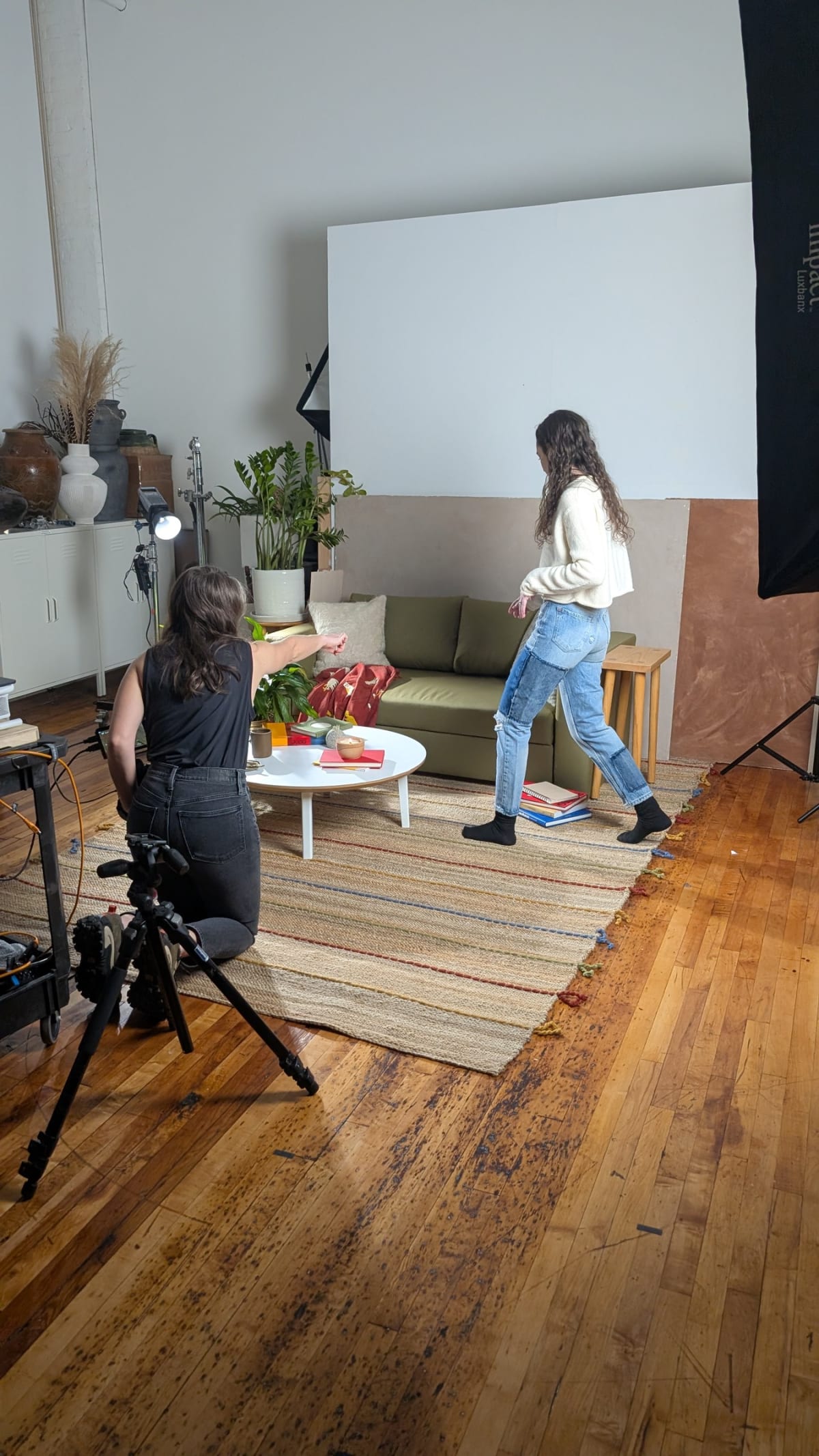
By late afternoon there was a living room in the middle of the studio, and it was convincing: a green sofa, a striped jute rug, a plant in a brass pot, a stack of art books, and behind it a wall in a warm clay tone that could not have suited us better.
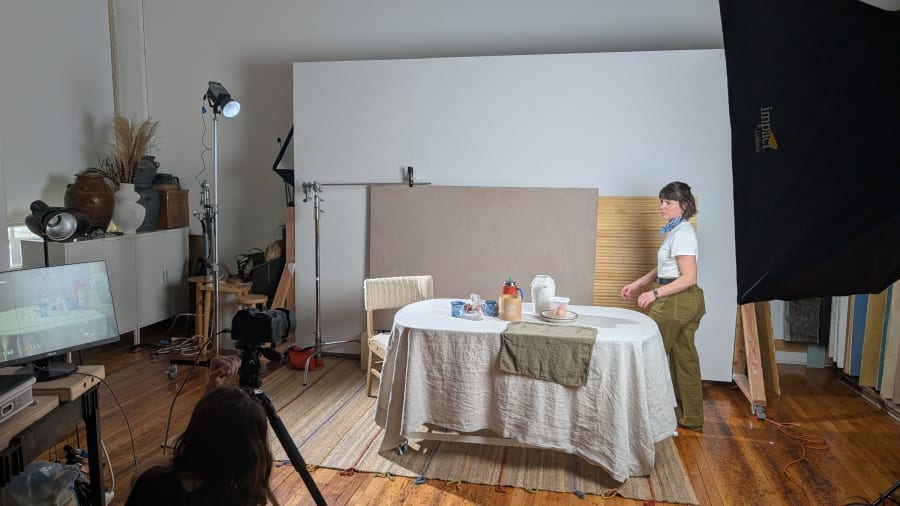
It isn't a wall. It's one of the hundred-odd surfaces they keep on the racks you can see at the edge of these frames, propped on a stand and lit until it reads as a room. Having that inventory in the building is the difference between imagining a scene and just building it.
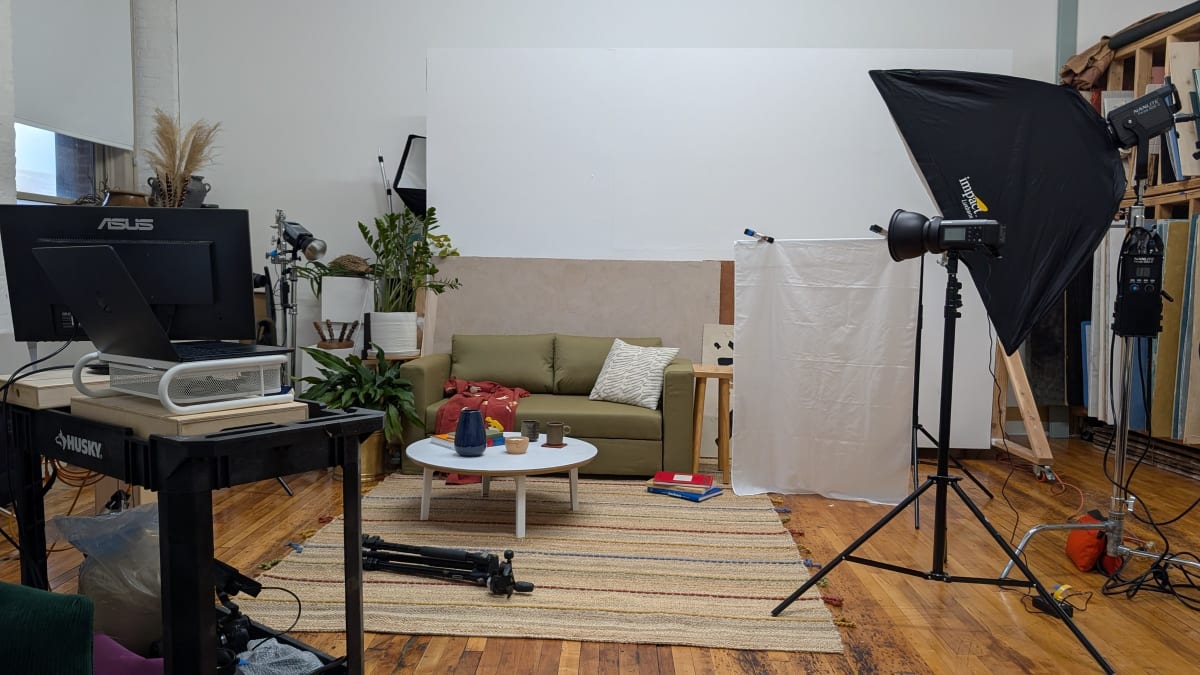
The rest of the room is ordinary furniture, and that's the trick. Knowing which everyday thing will photograph like an expensive one, and which expensive one will photograph like nothing at all, is most of the job.
Day 2: the shoot
Crew call was 8:00, they asked us for 8:30, and the model came in at 9:00.
Six people worked that day, and almost none of it looked the way we expected. The surprise was how much of a shoot is decision-making. Giulietta would move a vase of pincushion protea two inches, stand up, look at the monitor, and move it again. From where we were standing the two frames looked identical. On the monitor they weren't, and once she pointed at what had changed we couldn't unsee it. That's what a decade of arranging objects for a living buys you, and it isn't that she sees more of the room, it's that she sees what the photograph is going to do with it.
Nick had a hard stop at noon, so every still and clip that needed him had been pulled to the front of the shot list the night before, and the morning ran like it had always been planned that way.
By late morning the set had been struck and rebuilt twice, first as a marble-topped table with a red enamel kettle, then as a linen sheet thrown over a round table with mimosa in a stone vase. By mid-afternoon there was a bedroom where the living room used to be, headboard and all.
Day 3: product on white
Saturday morning, Emily put a sweep up in the corner of the studio and shot the e-commerce frames.
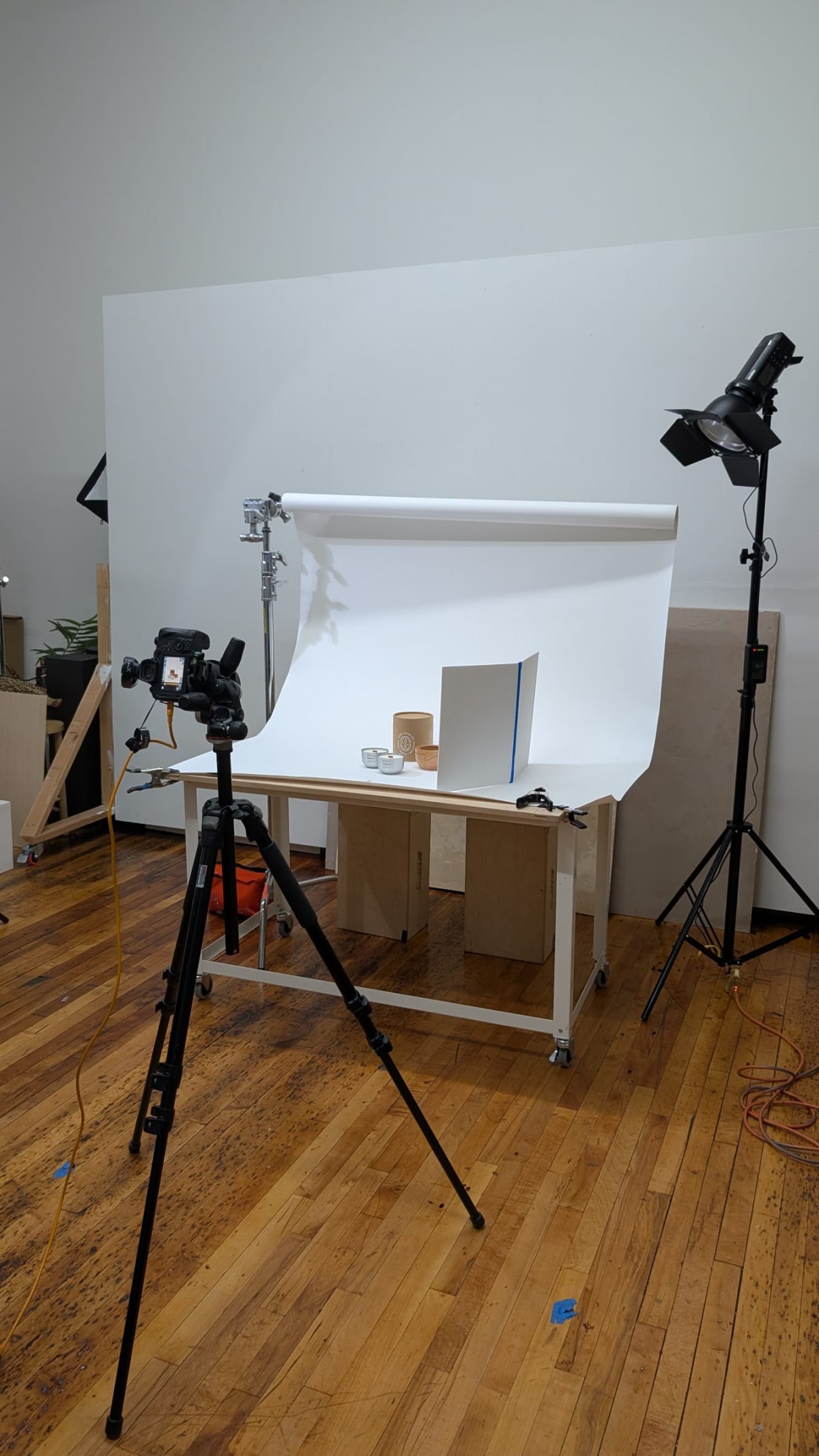
These are the frames that carry the material detail: the laser etching where a paper label would be, the grain that runs differently through every beech container, the split line where the two halves meet. They're the least dramatic images from the whole shoot and they're on our product pages doing more work than anything else we have.

What came back
A few weeks later the first round of photos landed, and the videos right behind them. Emily also sent over a contact sheet of everything else she'd captured that day, which is how we've been able to go back for more frames since.
What we wrote to the team that evening still covers it:
It's very cool to see the brand represented in such a grown up brand way.
That was the shift. Before those three days our site looked like exactly what it was, a small company with a good product and photos taken on a kitchen counter. Afterward it looked like a brand.
Set next to our own phone shots from the same afternoons, the distance is the whole story.
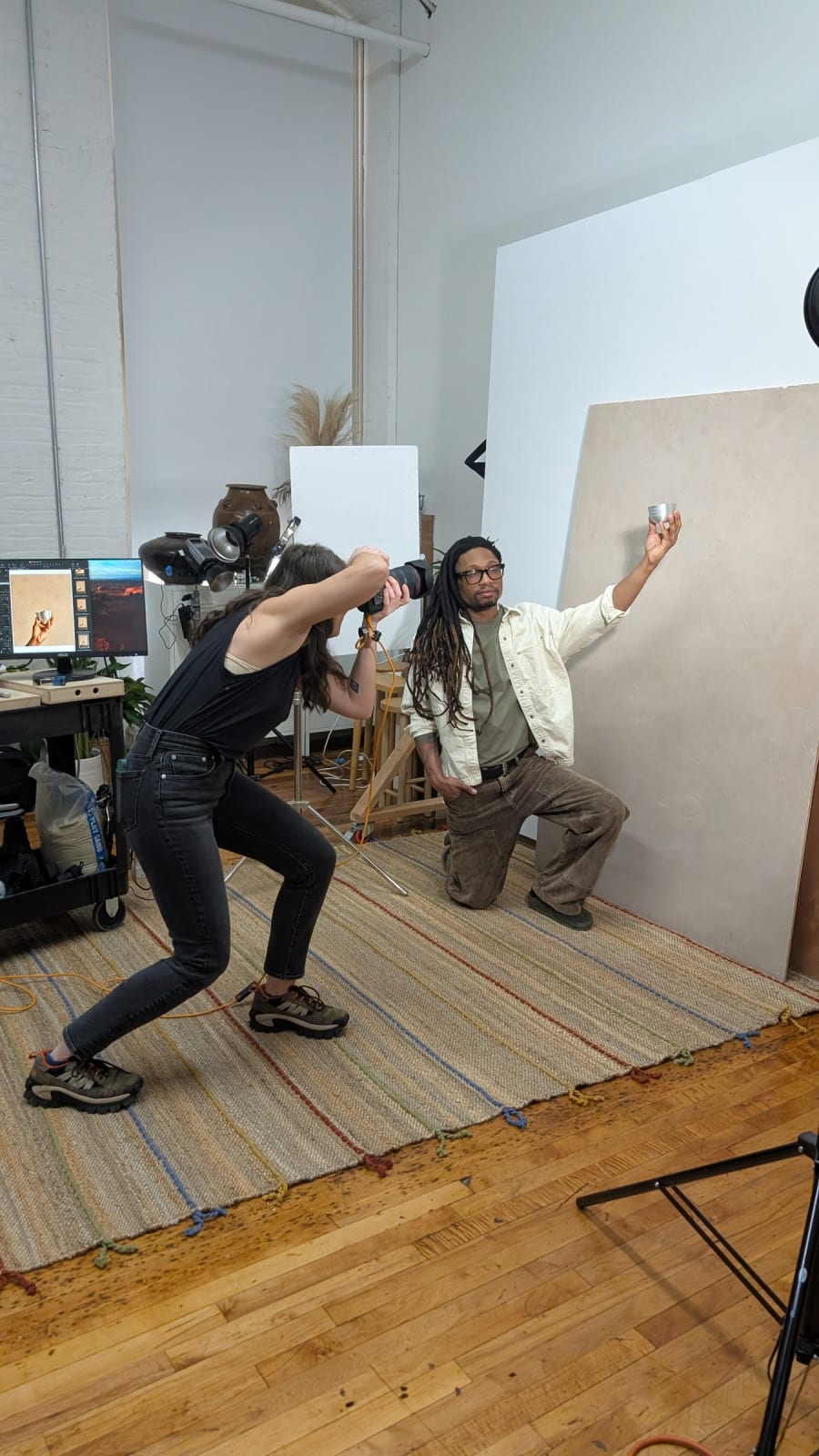
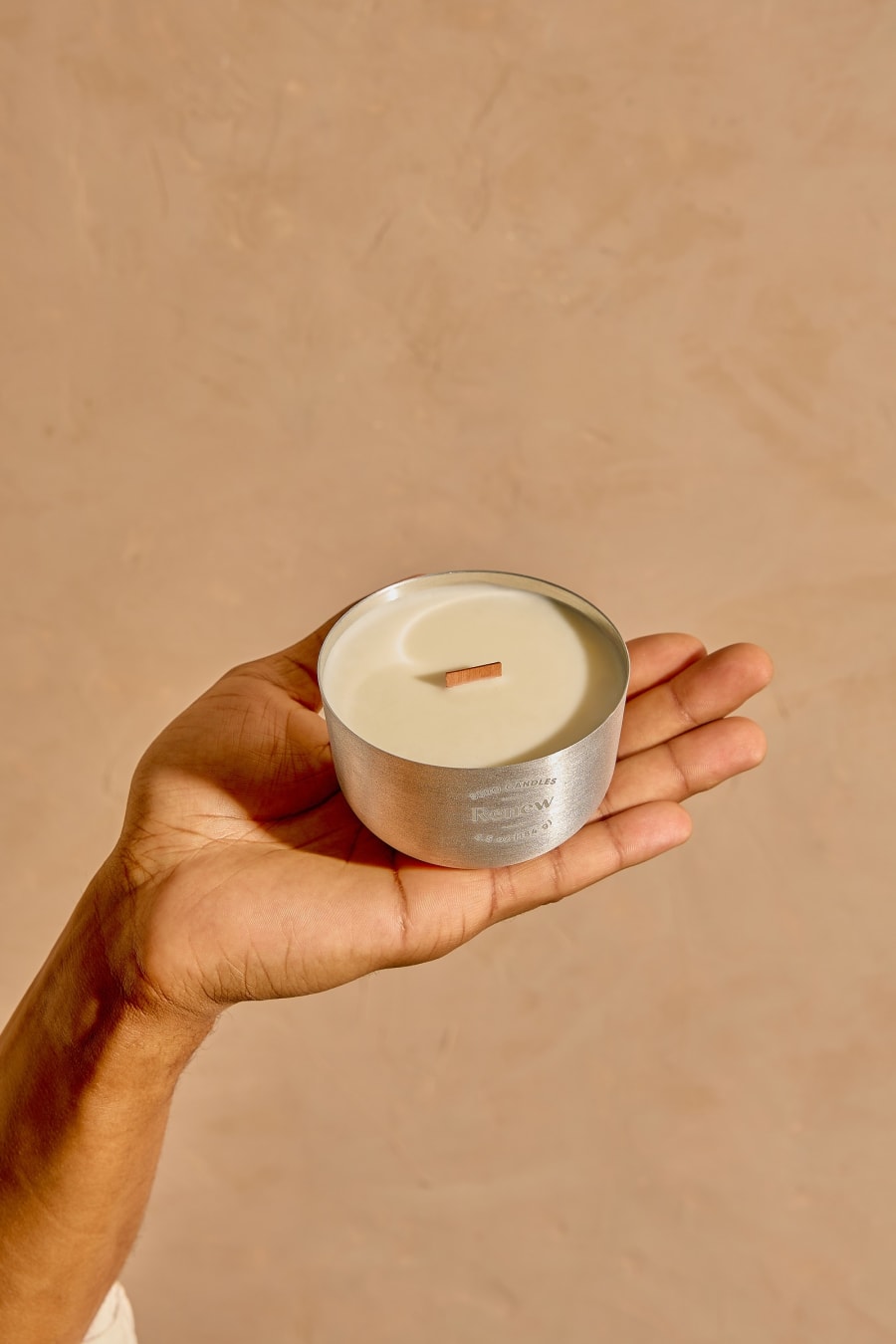
Same corner of the room, an hour or so later.
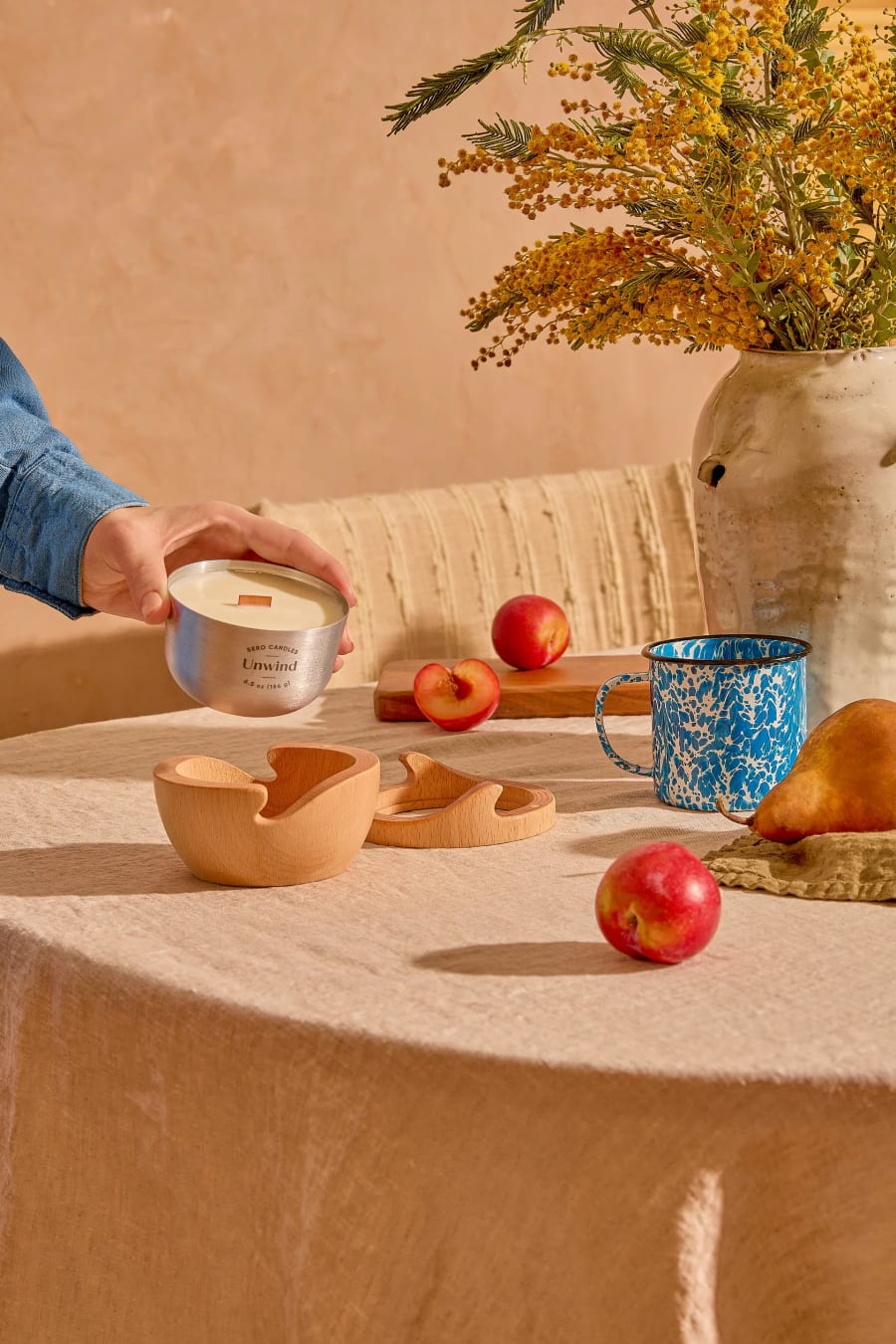
And the same room again by mid-afternoon, rebuilt as a bedroom.
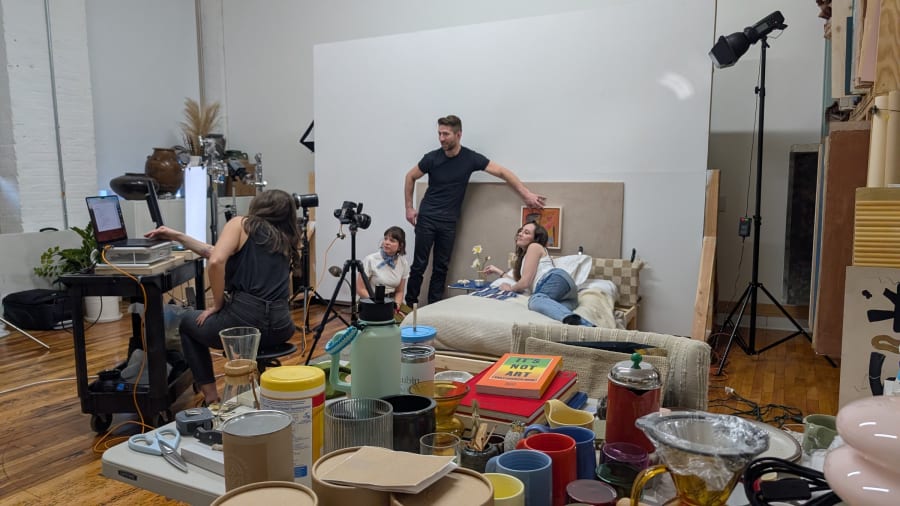
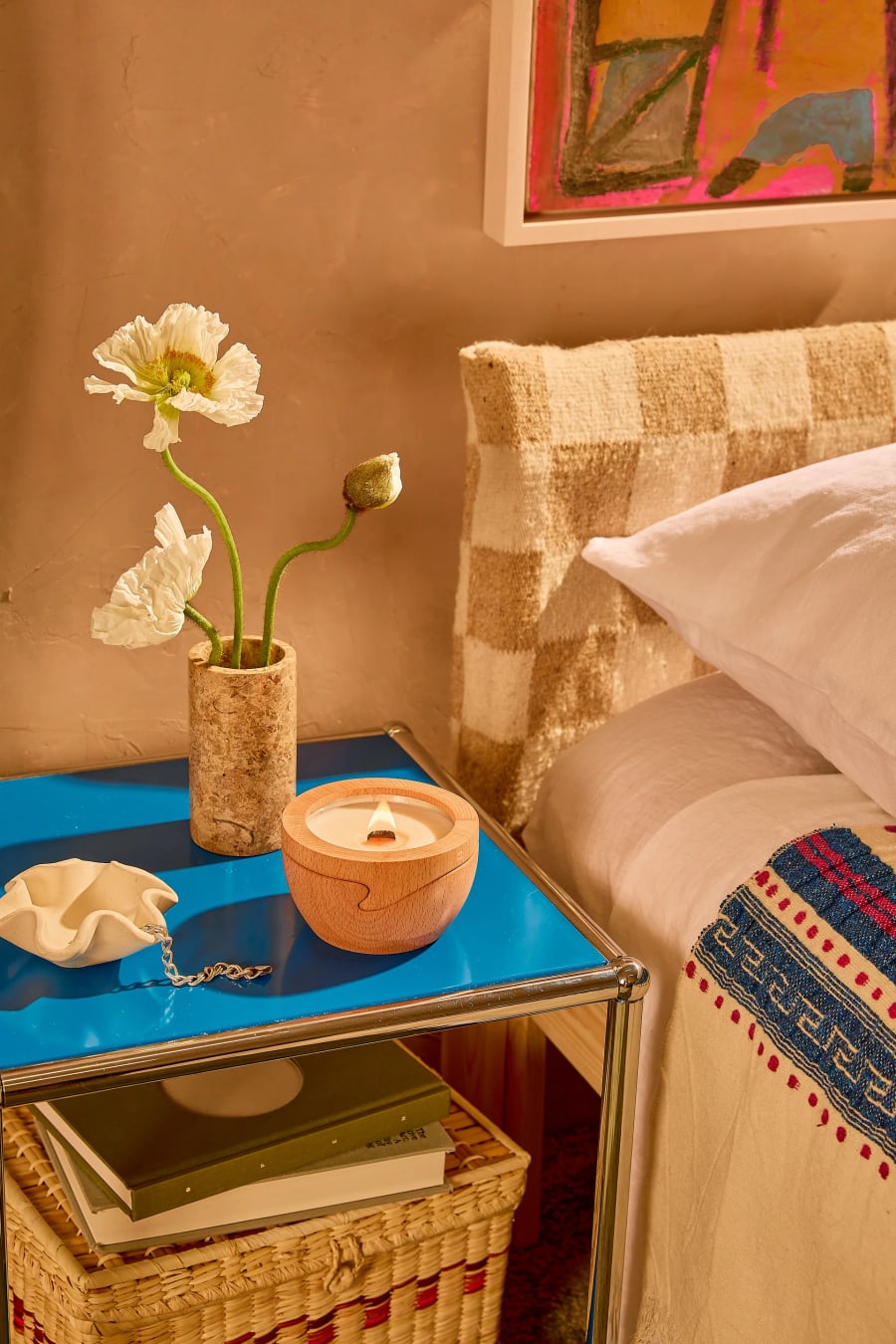
None of that shows up anywhere in the finished frame. Building only what the camera is going to see, and building it precisely enough that the whole thing reads as somebody's room, is the entire job.
Six months on, those images are on our homepage, on the product pages, in every email we send and in every press kit that goes out. Three days in February is still carrying the brand in August.
We didn't get this team by being a big account. We got it because we were lucky enough to know them, and because they'd already decided that part of their calendar belongs to companies like ours. The first one was luck. The second is something they choose to do, and it's worth knowing about if you're running something small and trying to work out how to make it look like itself.
Credits
Branding, art direction and styling by Limonata Creative.
Photography and video by Emily Marie Schultz.
Model: Nick Wright, repped by The Artist Agency. Model and styling assistant: Chelsea Baldwin.
Shot at Prop Up Shop in Baltimore, Maryland.
More on how the rest of it gets made.


